If you own an Audi with the later 3.0 TDI V6 (EA897 Gen-3 / evo2), you’ll know it’s a fantastic engine — smooth, torquey, and efficient. But beneath the surface, there’s a widespread issue many owners and independent specialists have flagged: low oil pressure at idle and light load.
Some owners have experienced full engine or turbo failure
This problem isn’t always a simple “fault.” In fact, it’s baked into how the engine was designed. But left unchecked, it can lead to serious wear and expensive repairs – even total engine failure. Here’s what’s really going on.
Why these engines run lower oil pressure by design
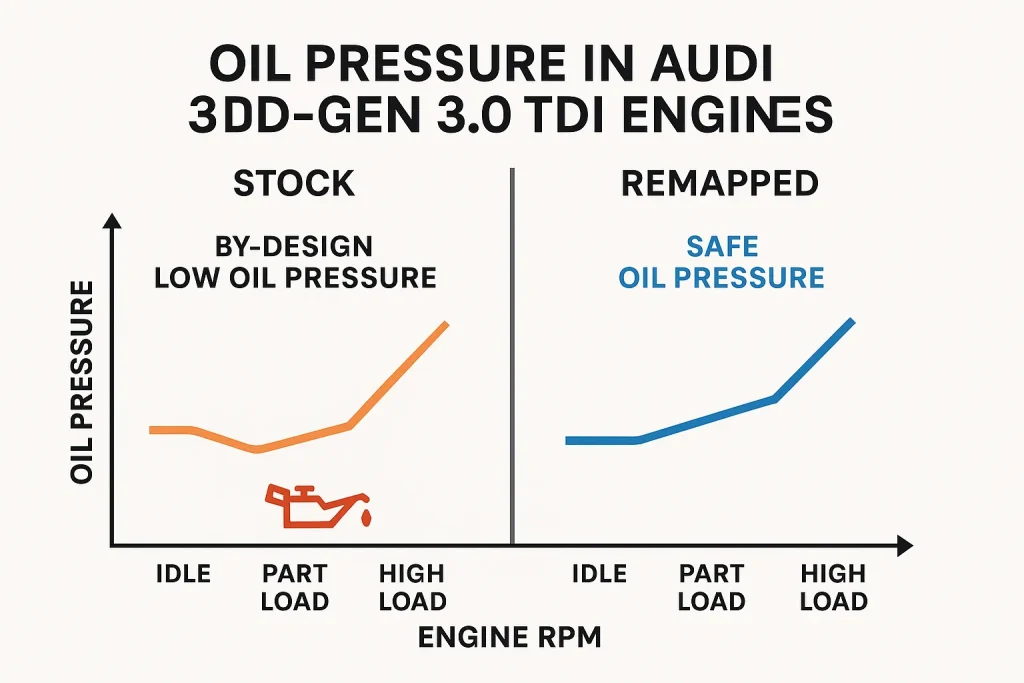
Audi moved to a variable, map-controlled oil pump on the Gen-3 3.0 TDI. Instead of pumping at a constant high pressure, the ECU tells the pump how much pressure is needed based on load and rpm.
At idle or light cruising, the ECU deliberately keeps pressure low to reduce drag and emissions. That works fine when everything is new and the oil is fresh. But as the miles climb, that low-pressure strategy leaves less margin for error.
Audi’s own training manuals (Self-Study Programmes) describe this behaviour as normal, and the system uses a control valve (N428) to regulate pressure. In other words, if your gauge shows low hot-idle pressure, it doesn’t necessarily mean the pump is broken — it might just be the ECU doing its job.
Where the problems start
Specialists across the UK and Europe have documented a worrying trend:
- Hot idle warnings – after a long run, the engine flashes a reduced oil pressure warning.
- Chain tensioner noise – low pressure means tensioners don’t stay fully primed.
- Bearing and turbo wear – the thin film of oil can’t always protect components.
- Oil dilution – repeated DPF regens and short trips thin the oil with diesel, dropping pressure even further.
Some owners have experienced full engine or turbo failure when low oil pressure and oil dilution combine.
What Audi says in its technical bulletins
Audi has issued technical service bulletins (TSBs) around “reduced oil pressure” warnings. These typically involve:
- Checking hot idle oil pressure with a mechanical gauge (minimum ~1.4 bar at 80 °C).
- Inspecting the oil filter housing’s internal rubber plug and spring, which can bleed pressure if mis-seated.
- Replacing those parts if they don’t meet spec.
In other words, Audi acknowledges that certain hardware can cause genuine faults — but it also states that relatively low readings at idle are part of the design.
How car remapping can help
“Whilst driving on the motorway, a warning of ‘low oil pressure’ came on … I stopped the car almost immediately when it was safe to do so … and it never started again.”
— 2016 Audi Q7 3.0 TDI owner.
This is where ECU calibration comes in. Because the oil pump is map-controlled, its behaviour can be adjusted in software.
Independent diesel specialists (ourselves included) have successfully:
- Raised the minimum oil-pressure targets at low rpm, giving the engine more protection when hot.
- Optimised regeneration strategies to reduce fuel dilution of the oil.
- Refined torque delivery to lower stress on bearings.
The result? A safer oil-pressure curve, less chain/tensioner noise, and longer life for turbos and bearings.
What you should do if you own one
- Don’t ignore oil pressure warnings — get them checked with a mechanical test.
- Stick to shorter oil change intervals with the correct spec oil.
- If you mostly do short trips, keep an eye on oil dilution.
- Consider a remap that optimises the oil pressure strategy — it’s one of the few preventative steps you can take that tackles the problem at its root.
Final thoughts
The Audi 3.0 TDI Gen-3 is an impressive piece of engineering, but its low-oil-pressure design leaves owners exposed to risk as the miles add up. Audi’s own documentation confirms that this behaviour is “normal,” but the real-world consequences say otherwise.
If you’d like advice on protecting your engine — or want to explore a software solution that raises the safety margin — get in touch with us today.
What Cars Could Be Affected
The 3rd-generation 3.0L V6 TDI (EA897 evo/evo2) is part of Audi/Volkswagen Group’s modular diesel family. It’s been in wide use since around 2014–2015 (euro 6 era) and appears in many models across Audi, VW, Porsche, and even some Bentley applications.
Here’s a breakdown:
Audi Models (most common)
- Audi A4 (B9) – 3.0 TDI quattro variants
- Audi A5 (F5) – coupé, Sportback, and cabriolet with 3.0 TDI
- Audi A6 (C7 facelift and C8) – multiple power levels (218–286 PS)
- Audi A7 (C7 facelift and C8) – 3.0 TDI ultra, 50/55 TDI
- Audi A8 (D4 facelift, D5) – higher-output versions (up to ~320 PS)
- Audi Q5 (FY) – 3.0 TDI quattro
- Audi Q7 (4M) – widely used, incl. 218, 272, 286 PS tunes
- Audi Q8 (4M) – 45/50 TDI badged versions
- Audi SQ5 TDI (in Europe) – with bi-turbo 3.0 TDI (EA897 evo2)
Volkswagen
- VW Touareg III (CR) – 3.0 V6 TDI (231–286 PS versions)
Porsche
- Porsche Cayenne (E3, some E2 facelift models) – 3.0 V6 TDI until diesels were dropped (market dependent)
Bentley
- Bentley Bentayga Diesel (2016–2018, Europe) – 4.0 V8 TDI mainly, but the 3.0 V6 TDI was also used in select markets
Power Outputs & Badging
- Early EA897 evo units: 218 PS, 272 PS
- Later EA897 evo2 (Gen 3B) units: 231 PS, 286 PS, plus bi-turbo variants up to 320 PS (SQ5, A8, etc.)
In short, if you’re looking at a 2014–2020+ Audi, VW, or Porsche with a 3.0 TDI V6, chances are high it’s the EA897 Gen-3 engine.